LCRC Award Jump-Starts Breast Cancer Research Collaboration
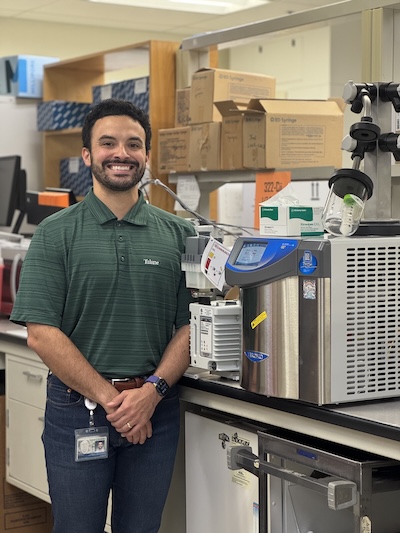
Above: Dr. Belgodere with research equipment purchased with LCRC New Investigator Award funds
Dr. Jorge Belgodere's promising breast cancer research is forging ahead with key support from the Louisiana Cancer Research Center.
A recipient of a 2024 LCRC New Investigator Award, Belgodere is developing a device to test potential breast cancer therapies on patient tissue samples while monitoring cancer cell behavior in real time.
A native of Lafayette, Louisiana, he serves on the research faculty at Tulane School of Medicine and is an adjunct instructor at LSU’s College of Engineering, where he earned his PhD.
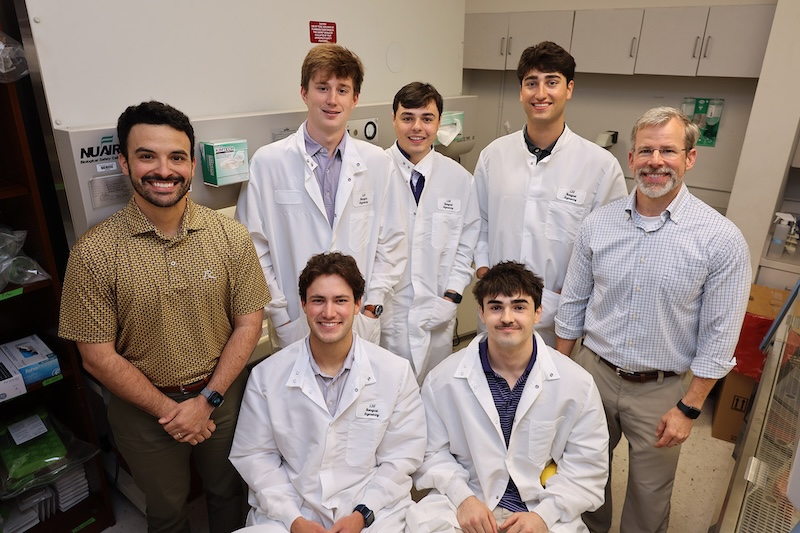
Belgodere is collaborating with colleagues at Tulane and LSU to create a platform that could help identify the most effective treatments for breast cancer. Tissue samples for the project are provided through Tulane, while LSU biological engineering students are building the system as part of a capstone design project under the guidance of LSU Professor Todd Monroe, Belgodere’s postdoctoral mentor.
His LCRC award enabled Belgodere to purchase two critical pieces of equipment: a freeze dryer and a cryo mill. “Those are absolutely necessary to process patient tissue and some of the biomaterials that we use to fabricate these 3D models, basically allowing us to set up a mini biofabrication core,” he said.
LCRC New Investigator Awards are designed to help early-career scientists establish independent research programs. When Belgodere joined Tulane in 2023, he worked from laboratory space provided by LCRC faculty member and Tulane Cancer Center researcher Dr. Matt Burow. As his research program expanded, Tulane provided him with dedicated laboratory space.
“Because of the work that I’ve been doing, Tulane was kind enough to offer me my own lab space,” he said, noting that the LCRC award played a pivotal role in that growth. “It was definitely a good infusion. Since getting that award, I’ve received multiple intramural awards. We just received an LCRC Seed Award, as well as some extramural funding. All of the preliminary data has pretty much come from that initial New Investigator Award.”
For Belgodere, the award provided more than equipment and funding—it helped position him for continued success as he competes for additional research funding.